PDFs were invented in the early 1990s and are still the primary method for storing and presenting data, and even many catalogs, brochures, and documents are presented in PDF format.
How should we provide our information to our customers?
Obviously, by sending the PDF of products or services to them.
How should we store bulky manuals and textbooks?
Naturally, in the form of a PDF.
We are all used to dealing with this format, which, of course, is also a familiar and reliable source of information.
What is it Like to Work with PDFs?
First, let's examine how different businesses work with PDFs daily, along with the advantages and disadvantages of using this format.
Marketers and sales representatives use PDFs to introduce the service products they offer, such as catalogs, brochures, price lists, etc. When meeting face-to-face with customers, they usually use printed or hard copies, and if there is a need to send content, they send the PDF version via email or social networks.
Manufacturers
Most manufacturers also have their product catalogs in PDF format. Such catalogs can be as bulky as 300-400 pages or even more. These files are sent to sellers or placed on the official website so that customers can download them.
Educational Institutions
Educational institutions also possess many of their materials in PDF format. They usually upload textbooks and educational materials to their website so that students can download and study them.
Sooner or later, all of these people—namely sales representatives, manufacturers, or students—face similar problems, a number of which are mentioned below:
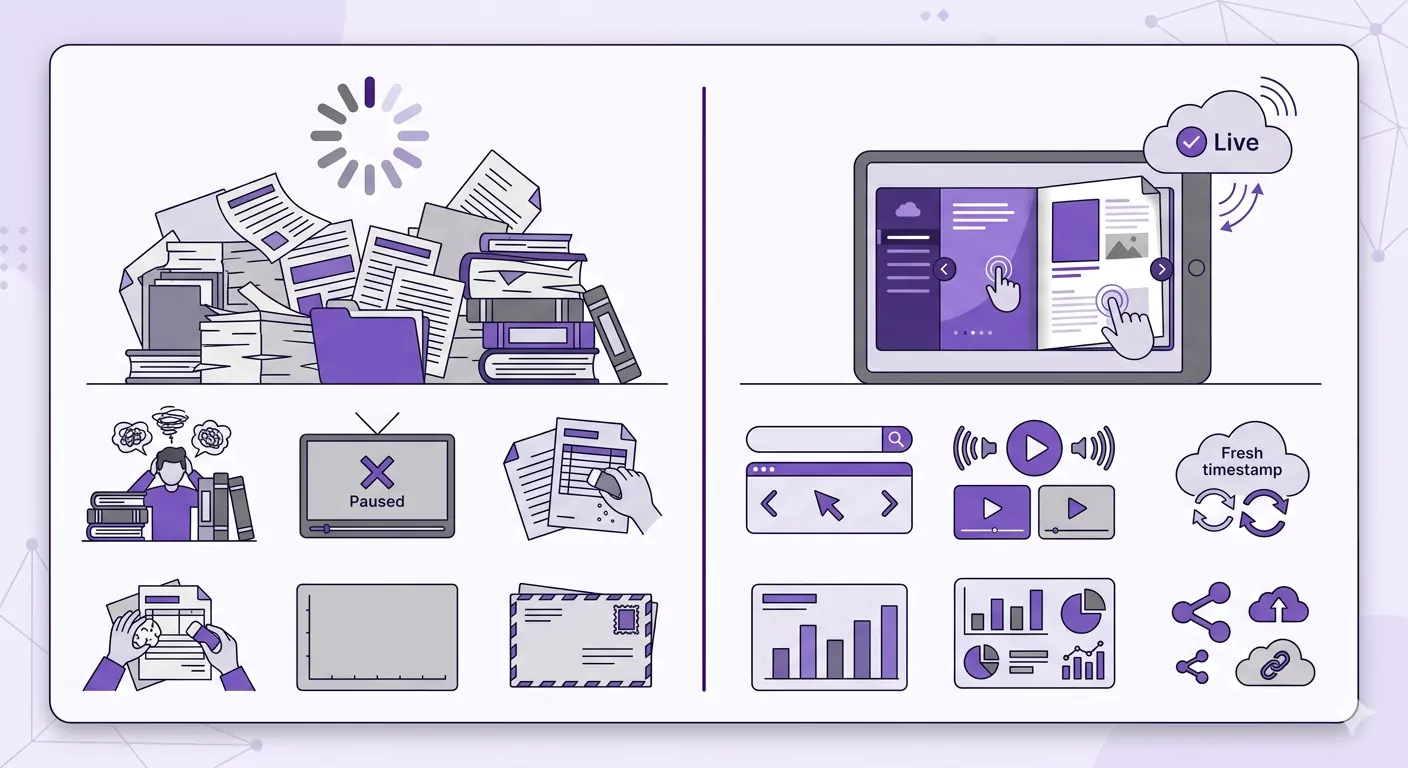
When they print all the PDF files they need, they are forced to carry a mountain of catalogs and a large amount of paper.
In today's fast-paced world, a simple PDF whose access depends on an internet connection sometimes causes problems. Sales representatives, who often work in places with poor internet connections, have to wait for the PDF to load. This can disrupt the flow of holding meetings and even affect their results.
Static PDFs do not have a very good quality and appearance on the web. They are hard to read. People face issues viewing PDFs in different browsers and on various devices, and finding specific information within a vast number of pages is extremely difficult.
After updating PDF files, a workaround must be found on how to replace them with the PDFs sent to customers prior to the modification. Do we have to call every single one of them and ask them to delete the previous file and download the modified file again? Is that even possible?
The significant point in this regard is that marketers cannot receive any statistical and analytical data about their PDF files, such as the number of views, resharing, customer reactions while reading the materials, what content they read the most, what content they ignore, and what information they like very much.
Are PDF Files the Best Choice?
As you can see, people who work with PDFs face many problems. This causes individuals to look for a new way to present all their data.
Almost one-third of the World Bank's PDF reports have never been downloaded, another 40 percent of the reports were downloaded less than 100 times, and only 13 percent were downloaded more than 250 times.
Studies have shown that PDF files are no longer the best choice for storing knowledge and data. For example, the World Bank, which invests about a quarter of its budget in the field of knowledge production services, recently conducted a study to see if anyone still reads its PDF files. The results were not encouraging for institutions that still store all their data in PDF format.
According to Christopher Ingraham in The Washington Post, almost one-third of the World Bank's PDF reports have never been downloaded, another 40 percent of the reports were downloaded less than 100 times, and only 13 percent were downloaded more than 250 times. Since most World Bank reports have a specific goal of public information or government policies, this seems to be a very poor record.
Which Format Should We Choose to Present Data and Content?
Your catalogs, brochures, and other documents contain valuable information, and it is natural that you try to present them in the best possible way.
First of all, do not worry. If needed, you can use PDFs in the conventional way. They are still one of the most widely used formats; people trust them.
But if you want to present your content to customers and audiences in a more captivating and better way than a PDF, build electronic pages so that you no longer face any of the mentioned limitations regarding PDFs. Audiences will not need to download the file, store it in the device's memory, and will not lose them in a mountain of stored PDFs without names, etc. This is even considered a convenient and practical way to transfer knowledge in educational and academic environments. So if you intend to publish your content practically and attractively, build interactive digital pages.
Lenoos online software can help you in this field. This platform allows you to convert simple PDFs into interactive online documents to publish your content beautifully and professionally, with the possibility to access and view them on any device.
It is sufficient to create a user account in Lenoos and very quickly proceed to upload your PDF files, and by customizing the display page of each, add to their captivating nature and attractiveness. If the number of your files is very large, do not worry at all; Lenoos has provided a professional and precise categorization for you to classify them based on subject, type, or your own taste. If you have content that you want only yourself to access, or you want to have a personal and categorized archive of your PDF files, Lenoos has made it possible for you.
Also, you might want to share content with a specific number of people; in this case as well, by creating a password for your files, viewing the file will be made possible only for those to whom you provide the password. Your files will remain in Lenoos as long as you have not decided to delete them, and the possibility of their publication and sharing will be provided. In Lenoos, the possibility of creating a book shop, newspaper counters, online library, entering an online store, ordering a product, and direct communication of audiences with you has been provided.
Lenoos features help your content in PDF format transform into your marketing assets.
Analyzing View Statistics and Increasing Sales
By analyzing Lenoos real-time statistics and the level of audience reception of digital catalogs, manage your marketing content in the direction of increasing sales.