

The Common Conception About PDF Catalogs
In recent years, instead of printing paper catalogs, many companies deliver PDF files of their products to customers via email, WhatsApp, or their websites. On the surface, this action seems positive because print runs have decreased and paper consumption has dropped. Nevertheless, PDF catalogs still have their own specific environmental and usability issues that are often overlooked.
Environmental Issues of PDF Catalogs
High Likelihood of Being Printed by Users
One of the biggest weaknesses of a PDF file is that users often print it out for easier reading or physical presentation to others. As a result, part of the initial paper savings is lost once again. Studies show a significant percentage of commercial PDF files are ultimately printed on paper.
Difficult Updates and Proliferation of Multiple Versions
Every time prices, specifications, or product images change, a new PDF file must be generated and resent. Older versions are rarely deleted and remain on users' systems and mobile phones. This leads to both audience confusion and the accumulation of unused digital files.
Poor User Experience and Increased Data Usage
Heavy PDF files, especially those containing high-resolution images, consume higher amounts of internet data. Furthermore, opening them on mobile devices is often cumbersome, encouraging users to print a paper copy instead.
Read More
Printed or Digital Catalog? Which One Causes Less Air Pollution?
Comparing the Carbon Footprint of Printed Catalogs vs. Smart Digital Catalogs
مهاجرت از چاپ به نشر دیجیتال؛ یک تصمیم استراتژیک برای بقا و رشد در عصر هوش مصنوعی
Environmental Benefits of Smart Catalogs
A smart catalog or interactive digital catalog represents an advanced evolution beyond PDF, offering distinct environmental advantages:
The need for users to print is drastically reduced because the reading experience on mobile and desktop is substantially smoother and more engaging.
Content updates instantly in real time, eliminating the need to re-send new file versions.
A single link replaces the repeated sending of heavy files, reducing overall bandwidth consumption.
The ability to embed video, audio, and interactive elements reduces the audience's inclination to seek a printed version.
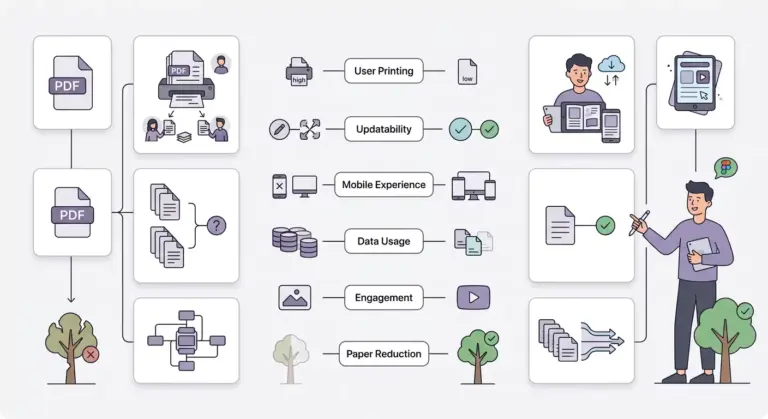
Direct Comparison: PDF vs. Smart Catalog
| Comparison Criteria | PDF Catalog | Smart Catalog |
|---|---|---|
| Likelihood of User Printing | High | Extremely Low |
| Updatability | Requires creating and sending a new file | Instant and without re-sending |
| Mobile User Experience | Medium to Poor | Excellent and Optimized |
| Internet Data Usage | Relatively High (Heavy files) | More Optimized |
| Engagement and Interactivity | Low | High (Video, animation, links & forms) |
| Final Impact on Paper Reduction | Relative Reduction | Dramatically High Reduction |
Do PDF Catalogs Have Any Advantages?
PDF catalogs remain useful for certain applications; for instance, when there is a need for a fixed static archive or formal document transmission. However, from the perspective of the environment and modern user experience, it is not an ideal choice. In fact, a PDF can be viewed as an intermediate step between a fully paper-based catalog and a smart catalog—a phase that businesses should transition past as quickly as possible.
Practical Action Plan for Businesses
The best approach is for businesses to bypass stopping at the PDF stage and move directly toward smart catalogs. Specialized digital catalog creation platforms make it possible to convert even existing PDF files into interactive, self-updating editions. This minimizes paper consumption while delivering a far more professional experience to the audience.
Final Words
Although a PDF catalog causes less environmental harm compared to a fully printed version, it remains far from complete or ideal. The high likelihood of user re-printing, difficult update workflows, and average user experience mean a significant portion of its environmental benefits is forfeited. By resolving these limitations, the smart catalog stands as a far superior choice for businesses that value both sales growth and environmental responsibility.


