Step-by-Step Guide to Designing Digital Catalogs in Adobe InDesign: From Scratch to Professional, Lightweight Output
Welcome to the world of professionals! If we consider a catalog a building, Adobe InDesign is exactly the engineering blueprint. You might feel overwhelmed by its numerous tools at first, but don't worry; for a standard digital catalog, we only deal with its vital sections. In this article, you will learn how to build a catalog that looks great on mobile and connects the customer to your site or WhatsApp with just one click.
Why is InDesign the Best Choice for Heavy Catalogs?
Unlike Photoshop, which is for image editing, InDesign is built for content management. Even if your catalog reaches 50 pages, InDesign handles it effortlessly. Furthermore, its Interactive features allow you to create real buttons and active links that work perfectly in the final PDF file.
Section 1: Getting Started and Initial Settings (The Foundation)
The first mistake beginners make is setting the document for print. For a digital catalog, the rules are different:
- Create New Document (Web Intent): When you press Ctrl + N, ensure you select the Web tab at the top. This automatically sets your color space to RGB (suitable for monitors).
- Smart Dimensions: If your audience mostly views the catalog on mobile, consider vertical dimensions (e.g., 1080 x 1920 pixels). For tablets or desktops, standard A4 (vertical or horizontal) works fine.
- Page Count: Don't worry, you can add pages later, but start with 8 or 12 for now.
Section 2: The Magic of Parent Pages (Time-Saving)
Imagine you want your logo and page numbers to repeat on all 50 pages. Do you copy them 50 times? No!
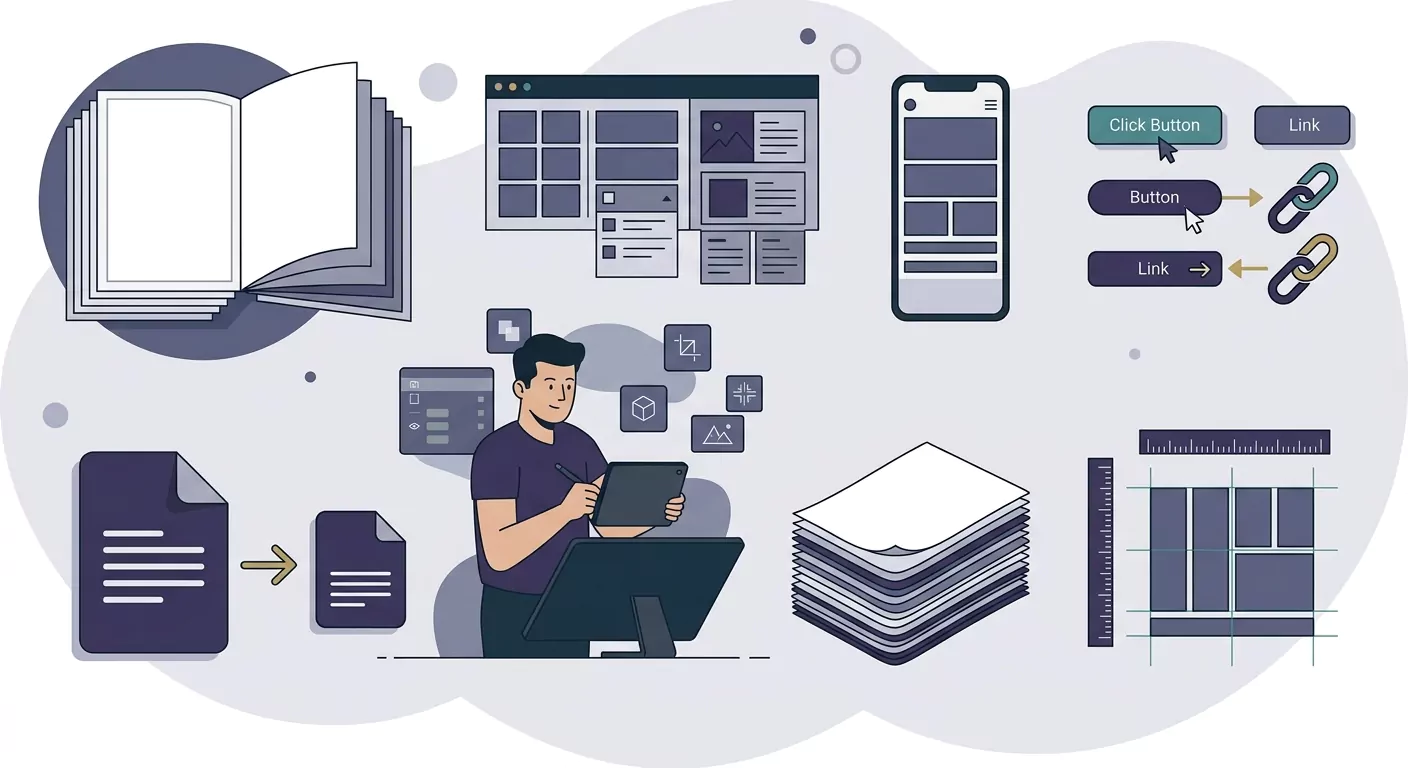
- In the Pages panel, use Parent Pages (formerly Master Pages). Anything you draw here acts as a permanent signature across all pages of the catalog.
Section 3: Text and Styles (Visual Order)
To keep your catalog organized, use Paragraph Styles:
- Define your font, size, and heading color once and save it as a style. Now, for all headings in the catalog, just click that style. This ensures a unified and professional look.
Section 4: Adding Clickable Features (Interactivity)
This is where your catalog transforms from a dead file into a sales tool:
- Linking: Select the text or image you want to link. Right-click, go to Hyperlinks > New Hyperlink, and enter your website URL or WhatsApp link.
- Table of Contents: You can make the TOC clickable so the user jumps directly to a specific product page.
Section 5: Exporting (Lightweight yet High Quality)
The biggest challenge is file size. If your catalog is 50MB, no one will download it on WhatsApp.
- Specific Export: Never use Export PDF (Print). Always choose Adobe PDF (Interactive). This format is designed for screens and keeps all links active.
Technical Summary & Implementation Checklist

Adobe InDesign Here are all the technical steps explained above, summarized as a roadmap for you to use during your workflow:
1. Project Startup Settings:
- Path: File > New > Document
- Top Tab: Select Web
- Unit of Measurement: Pixels
- Facing Pages: Enable if you want pages to be side-by-side (like a book); disable if designing for mobile scrolling.
2. Managing Recurring Elements:
- Open the Pages Panel
- Double-click on A-Parent
- Place the logo, page numbering (Type > Insert Special Character > Markers > Current Page Number), and fixed elements.
3. Importing Images (Quality vs. Size):
- Use the shortcut Ctrl + D to import images (Never copy-paste).
- Right-click the image and select Fitting > Fill Frame Proportionally for precise placement.
4. Creating Buttons and Links:
- Select the desired object.
- Path: Window > Interactive > Hyperlinks
- Enter the address (URL) in the designated box.
5. Final Export Settings (Ultra-Optimized):
- Path: File > Export
- Format: Adobe PDF (Interactive)
- In the General section: Enable Optimize for Fast Web View.
- In the Compression section: Set Resolution to 144 or 150, and Image Quality to Medium or High (depending on the number of images).
- In the Advanced section: Ensure Display Title is selected to show the brand name in the browser.
Adobe InDesign Golden Checklist
Ideal for: Heavy, industrial, multi-page, and ultra-professional catalogs..
A) Infrastructure & Preparation
- [ ] Intent Setting: In the New Document window, set the Intent to Web to automatically switch the color space to RGB.
- [ ] Facing Pages: Enable this if the catalog is designed for a flip-book layout; otherwise, disable it for vertical scrolling.
- [ ] Parent Pages: Set up page numbering, logos, and recurring elements on Parent Pages (formerly Master Pages).
B) Text & Style Management
- [ ] Paragraph Styles: Create styles for all headings and body text so the entire catalog can be updated with a single click.
- [ ] Character Styles: Create separate styles for keywords or prices that require distinct coloring or formatting.
C) Interactivity
- [ ] Hyperlinks: Ensure all web addresses and emails are converted into active links.
- [ ] Buttons: Use the Buttons and Forms panel to create interactive "Buy" or "Contact" buttons.
- [ ] Bookmarks: Convert the Table of Contents into Bookmarks so they are clickable in the final PDF.
D) Export & File Engineering
- [ ] Export: Ensure the export format is set to Adobe PDF (Interactive).
- [ ] Compression: In the compression settings, set resolution to 150 DPI and image quality to Medium.
- [ ] Linearized PDF: In the Advanced tab, check the Optimize for Fast Web View box.