Integration with CRM: Converting Interaction into Sales Data
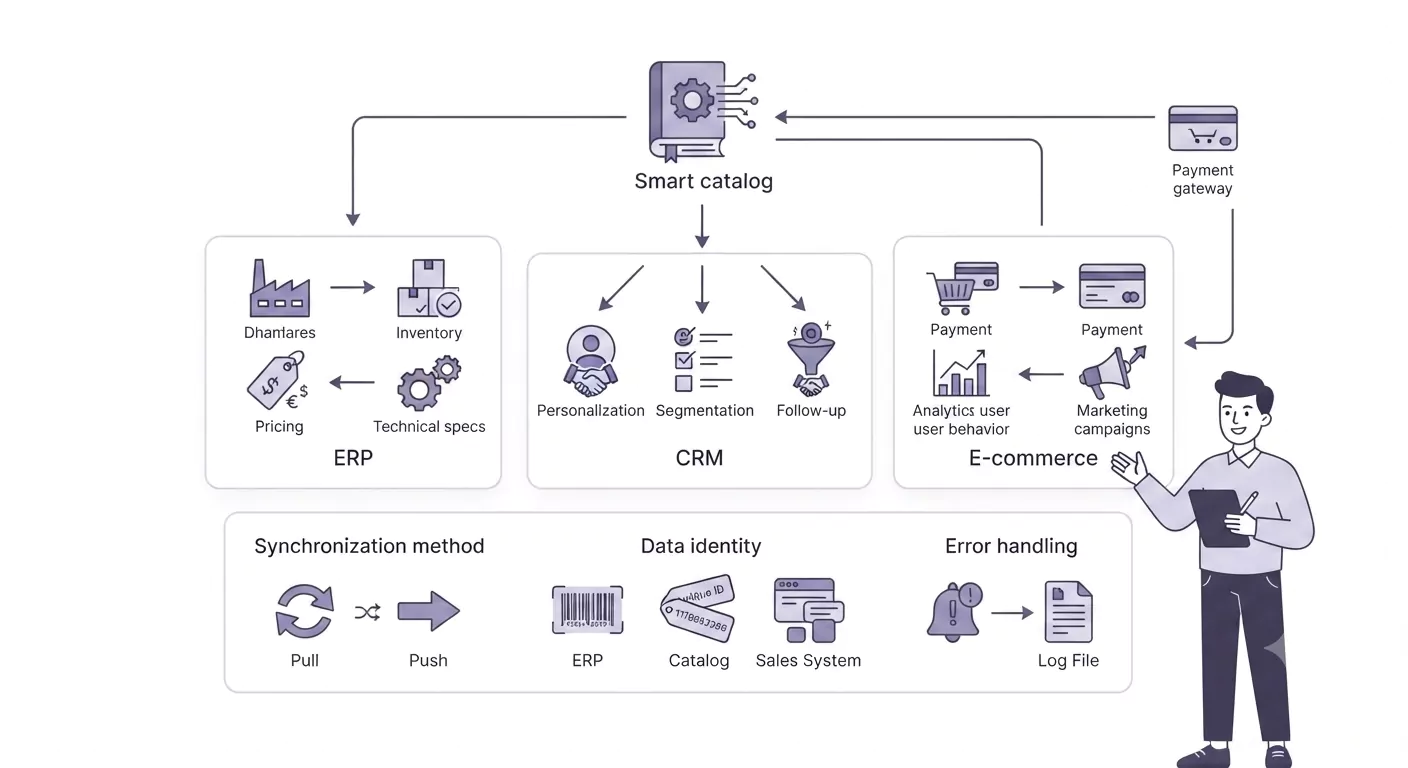
The main goal is to convert customer interactions with the catalog into trackable actions for the sales team.
A) Automatic Logging of Leads and Activities
- Frictionless Leads: When a customer fills out the lead capture form (Content Gating) in the catalog, their information is automatically registered as a new lead in the CRM.
- Logging Behavioral Activities: All key customer behaviors (e.g., catalog browsing duration, products clicked, and videos watched) are recorded as a "Lead Score" or a note in their CRM file.
B) Accurate Lead Scoring
By logging behavioral data, the CRM can automatically score leads.
- Sales Prioritization: A lead who has opened the catalog 10 times and viewed the pages related to the Flagship product receives the highest score, and the sales team immediately follows up with them.
- Result: This automation directs the sales team's time away from guesswork and towards targeted, profitable activities.
Integration with ERP: Real-Time Accuracy in Product Information
The ERP (such as your inventory management and accounting system) is the Single Source of Truth for prices and inventory.
A) Automatic Price and Inventory Updates
The most important advantage of ERP integration is that prices no longer require manual updates.
- السيناريو: عندما يتغير سعر مادة خام أو يصل مخزون منتج ما إلى الصفر، يتم تطبيق هذا التغيير في ERP، ويتم تحديث الكتالوج الذكي في اللحظة ذاتها.
- Advantage: Prevention of selling an out-of-stock product or quoting the wrong price to the customer, which protects brand credibility.
B) User-Role Based Price Personalization
In B2B transactions, the final product price may vary based on purchase volume or the Dealer Tier.
Dynamic Pricing: By connecting the catalog to the ERP database, the smart catalog can dynamically display prices specific to each sales representative or dealership after their Login, without the need for multiple catalog versions.
Technical Requirements for Successful Integration
This process requires infrastructure and standards for sustainable integration.s
A) Use of APIs (Application Programming Interfaces)
The digital publishing platform must have a robust and open API to communicate with CRM and ERP systems. This API allows data to be exchanged bidirectionally and with complete security (Push/Pull Data).
ب) حفظ امنیت دادهها
Since sensitive information (financial and customer data) is being exchanged, security protocols such as Encryption and adherence to authentication standards are vital for maintaining data confidentiality.
Final Words
Integrating the smart catalog with CRM and ERP transforms the sales process from Reactive to Proactive. This automation ensures that the sales team always has the most accurate, up-to-date information and spends their time following up with leads that the system, based on behavioral data, has classified as the best chance for a sale. A system-connected smart catalog is an asset that literally makes money for your business.