Discovering Latent Demand via Behavioral Analysis
Customers "tell" you what they want through their interactions, even if the product doesn't exist yet.
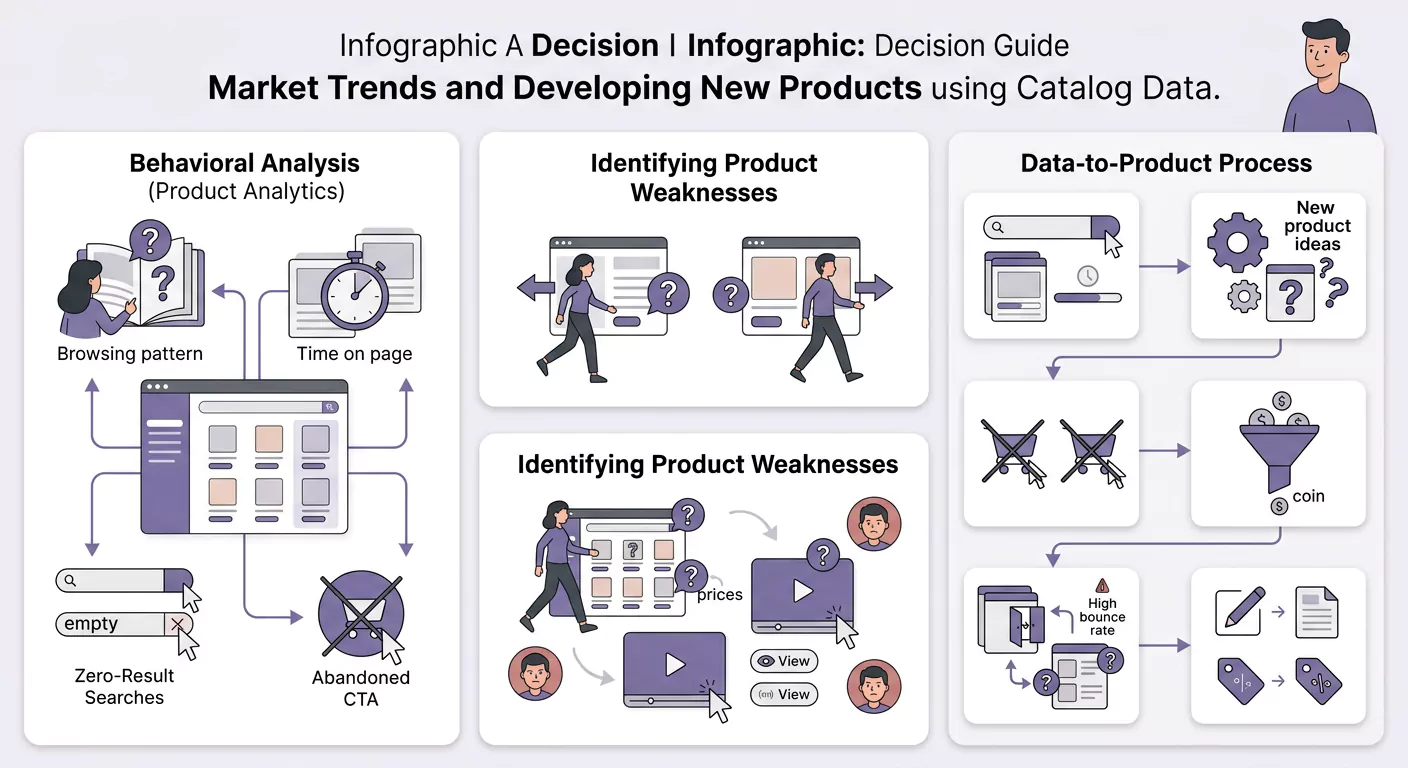
Flip Rate and Dwell Time
Time If a specific section of the catalog (for example, "New Accessories") possesses a very high flip rate and long dwell time, this is a strong signal that the market is interested in that product category.
This indicates that more accessory products should be produced in that category or the after-sales service department should be strengthened.
Zero-Result Searches
keywords that users enter into the catalog's search bar, but for which no results are found.
These are precisely the unmet needs of the market. If people look a lot for "Smart Model [X] with Capability [Y]", this is a strong candidate for your new product production.
High Clicks on Failed CTAs
The user clicks on a CTA ("Request a Quote" or "Technical Specifications") but does not complete the process or exits the catalog.
This indicates that the product possesses initial attractiveness, but there is not enough transparency in vital information (such as price or technical capability). The product production team must place this information in priority.
Identifying Weaknesses in Existing Products
Catalog data highlights which products are underperforming and need improvement.
High Exit Rate Pages
Pages where users immediately leave the catalog indicate a problem—likely high pricing, poor layout, or insufficient data.
- Pages where users immediately leave the catalog indicate a problem—likely high pricing, poor layout, or insufficient data.
- If product videos have minimal views, either the content quality is poor or the product itself lacks enough appeal to capture the customer's time.
Low Engagement with Multimedia
product videos have minimal views, either the content quality is poor or the product itself lacks enough appeal to capture the customer's time.
Transforming Data into a Product Roadmap
To use this data effectively, a structured process is required:
| Analysis Phase | Required Catalog Data | Strategic Output |
|---|---|---|
| Idea Discovery | Zero-result searches, High dwell-time pages | Raw ideas for new features and products |
| Validation | Click data on "Add to Cart" for similar items | Prioritizing ideas with the highest conversion potential |
| Optimization | High exit rate pages, High bounce rate | Immediate review of features, pricing, and content |
Read More
Video Content Strategy in Catalogs: Utilizing Video for Product Pages with Low Conversion Rates
Leveraging UGC in Smart Catalogs: Boosting Brand Trust and Conversion Rates
The Importance of CDN in Digital Catalogs: How to Optimize Loading Speed by 100%?
Comprehensive Guide to Smart Digital Catalogs and Content Marketing in 2026
Final Words
The smart catalog is the ultimate bridge between marketing and product development teams. By intelligently analyzing behavioral data, managers can move away from intuition and make evidence-based decisions. This ensures your production line remains aligned with real customer demands, significantly increasing the success rate of new launches.