Commissioning Challenges in the Traditional Model
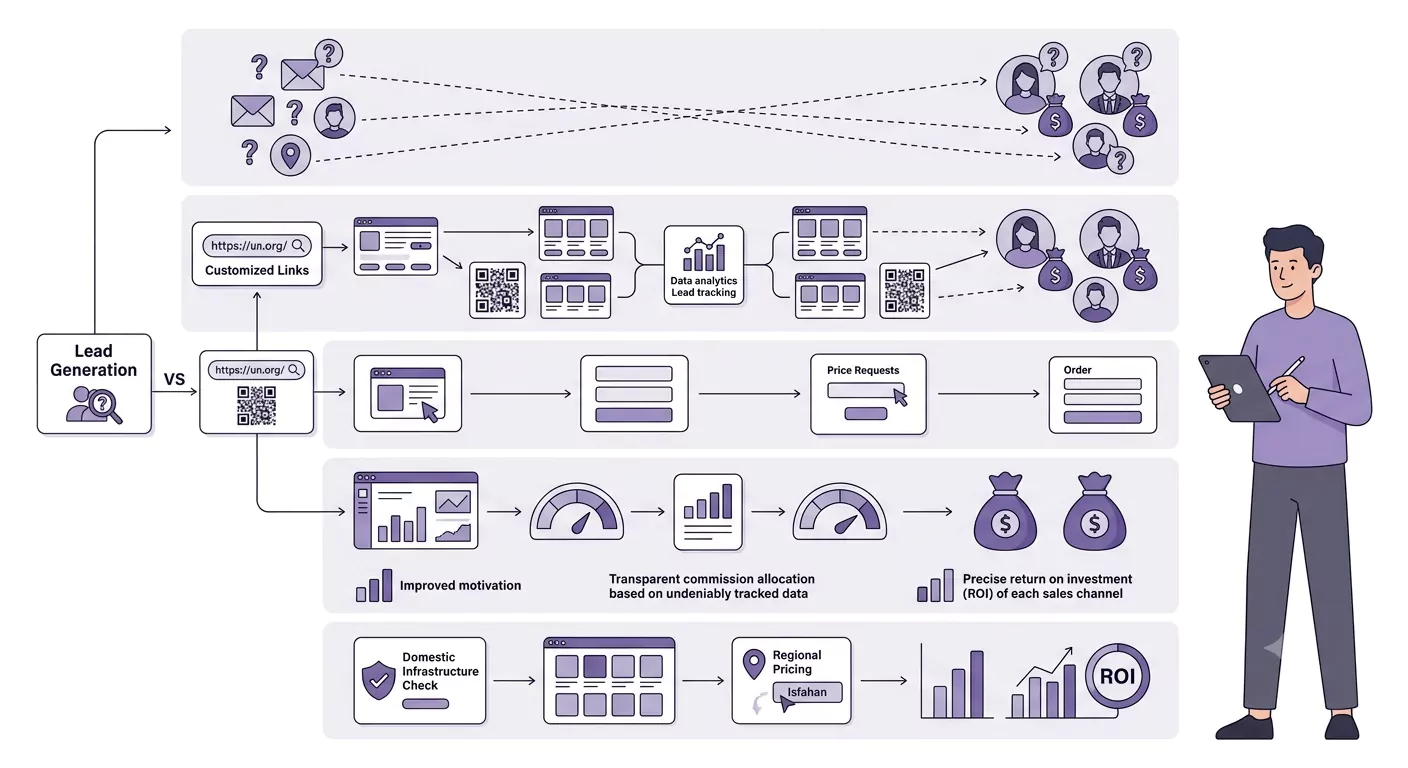
In traditional sales, it is often very difficult to accurately track the source of a lead or final sale.
A) Confusion in Lead Allocation
When a customer acts through different channels (for example, first Instagram and then the representative's email link), determining the final source of the sale becomes challenging.
B) Lack of Behavioral Insight
The sales representative cannot understand which pages the customer browsed or which product they viewed after receiving the catalog link. This lack of information makes targeted follow-up difficult.
2. Implementing the Affiliate System with a Smart Catalog
The smart catalog acts as a tracking hub.
A) Generating Customized UTM Links
Create a separate link to the smart catalog for each sales representative or affiliate partner that contains a unique UTM parameter.
- Example: (yourcatalog.com/?utm_source=affiliate&utm_medium=rep_lili)
Advantage: The marketing team can see exactly in the catalog's analytics system (Analytics) how the traffic from "rep_lili" performed.
B) Deep Tracking Up to the Conversion Stage
The smart catalog analytics system must be able to track user behavior inside the catalog beyond the initial click:
- Visited Pages: The representative understands which product category the customer showed the most interest in.
- Click-Through Rate on CTA (Lead Form/Price Request): Measuring the high-quality leads generated by each representative.
- Final Order: In case of connection to a CRM, the final sale can be attributed to the same UTM link.
C) Automated Performance Reports for Representatives
The platform can provide each representative with a dedicated dashboard to view the performance of their UTM links: "You had 100 visits, generated 30 high-quality leads, and achieved 5 final sales." This report guarantees transparency and builds motivation.
Strategic Applications in B2B and B2C Sales
Utilizing this model is highly effective in large, distributed organizations.
A) Measuring the ROI of Each Channel
By comparing UTM data, managers can determine which representative or channel (for example, sales via Telegram vs. sales via email) is more effective and optimize their resources.
B) Personalizing the Catalog for Representatives
A password-protected login system can be utilized to display customized versions of the catalog to representatives. For instance, in the "Isfahan Branch" catalog version, prices and special products unique to that region can be displayed (Personalized Content).
C) Resolving Commission Disputes
Since all data and clicks are automatically tracked and recorded based on the UTM link, disputes related to commissioning are resolved based on undeniable data.
Final Words
Affiliate marketing with a smart catalog transforms the commissioning and sales representative management process from a challenging task into a completely transparent and data-driven system. By utilizing customized UTM links and deep tracking of user behavior, businesses can accurately measure the performance of each business partner, increase their motivation, and build an expansive and high-yielding sales ecosystem.