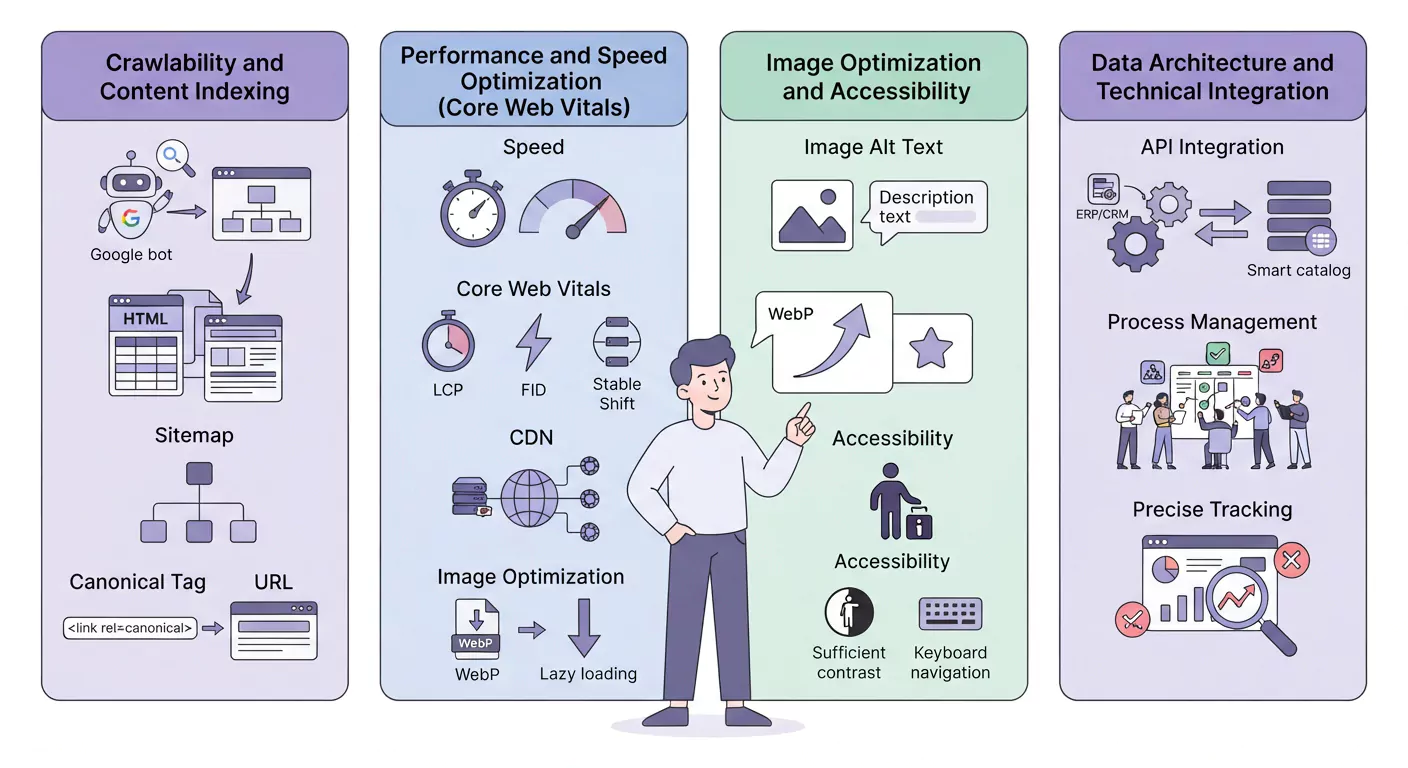
How can we enhance website SEO and attract more customers through remarketing using Lenoos flipbooks?
One of the primary goals of content production and publishing is to acquire rankings from search engines. Customers must find us on the very first pages and top rankings. A digital catalog contains various types of content that can be utilized for SEO optimization.
Here, we have explained how Lenoos flipbook content helps achieve better visibility by search engines and impacts your marketing.
1- 1. Driving Traffic from Search Engines to the Website with Lenoos Flipbook
Once your catalog becomes digital, it can be indexed by web crawlers in search engines such as Google, Bing, Yahoo!, Yandex, and Baidu. The possibility of SEO optimization with a digital catalog provides the opportunity to gain higher rankings, traffic, and sales from these search engines.
Implementing the following key method increases the chance of a favorable ranking for your catalog in search engines:
Invest time in keyword research and selection
The first and one of the most important steps in driving relevant search traffic to a digital catalog is choosing the right targeted keywords. Investing time in keyword research and selection allows you to identify, include, and optimize the most relevant terms with high search volume. Effective keyword research can also be utilized to inform product naming, including terms that are associated with increased conversions.
You can leverage the following tools to conduct effective research and select keywords:
- Google Ads Keyword Planner
- Microsoft Advertising Keyword Planner
- Moz Keyword Explorer
- Moz Keyword Explorer
2-2. Optimizing Metadata and Using Google and Microsoft Remarketing Tags
Adding meta tags to the HTML content of a digital catalog is crucial in describing your content to search engines. The title tag and meta description influence how your result is displayed in search engine results.
An optimized title and description act as a powerful advertisement for your online catalog landing pages, increasing click-through rates (CTR) and consequently driving more traffic from search engines.
A quick look at Metatags.org provides you with a comprehensive overview of the metadata you need to optimize your online catalog. Add schema (Schema.org) for better processing of content by search engines.
Schema.org is a structured markup that you can add to the HTML documents of your digital catalog. Schema ensures that your content is better processed by major search engines like Google, Microsoft, Yandex, and Yahoo!
Achieving rich snippets on Google can be incredibly beneficial. Ben Goodsell—a leading SEO consultant—reports that a page with a rich snippet feature on Google led to a 300% increase in CTR, while simultaneously driving a 677% increase in revenue from organic traffic.
Two types of highly useful schemas to apply to your digital catalog are the product markup and offer categories. If you want to display your products in the Google Merchant Center, adding this type of structured data will be extremely beneficial.
Remarketing tags for Google Ads and Microsoft Advertising
Remarketing is a powerful strategy in PPC advertising to re-engage customers who have interacted with your digital catalog. Remarketing gives you a second chance to reach users and achieve more sales, even after they have left your digital catalog or abandoned their shopping cart.
Both Google Ads and Microsoft Advertising offer remarketing functionality as part of their advertising platforms.
Build segmented lists throughout the purchase stage
An effective strategy in remarketing is creating segmented lists based on the user's purchase stage. This allows you to better target and optimize individuals to increase conversions.
In remarketing, you can create individual lists based on the specific pages the customer has visited. Combining these lists allows you to create custom audiences that you can target with personalized advertisements.
Below are three common combinations for segmenting and targeting users at different stages of the buying cycle:
- All users who visited a product page, but not the order form.
- All users who visited the order form, but did not see the form completion page
- All users who saw the order form completion page.
Use dynamic remarketing for relevant product advertisements
By combining a Product Feed, custom tags, and responsive display ads, you can create a dynamic advertisement that displays the exact product the user was viewing. These highly relevant advertising experiences are an excellent way to increase sales. Netshoes, the world's largest online retailer of sports equipment, achieved 30% to 40% sales growth during the Christmas season using dynamic remarketing. Similarly, the commercial unit of Sierra Company brought about a 400% increase in conversion rates using dynamic remarketing compared to regular remarketing campaigns.

33. Focusing on Conversion Rate Optimization (CRO)
Conversion Rate Optimization is the practice of increasing the percentage of users who perform a desired action on your website. An online catalog perfectly provides the opportunities offered by CRO strategies.
By moving online, you possess the power to track user behavior within your catalog using tools like Google Analytics. This means acquiring key metrics such as conversion rates on landing pages, traffic sources, etc. Using analytical data and CRO tools, you can initiate experiments to improve the conversion rate of digital catalog visitors to increase sales.
For example, you can alter the font size of headings, try a new page layout, test alternative product descriptions, change the color of call-to-action (CTA) buttons, and more. Thanks to the possibility of instant updates for online catalogs, you can start gathering data on the impact of changes as soon as they are published.
Tools to start the Conversion Rate Optimization journey:
Beginner's Guide: HubSpot and Qualaroo
Testing Tools: A/B Testing – Google Optimize and Optimizely
Heatmaps and Session Recording Tools: Hotjar and Crazy Egg
Customer Feedback Tools: Qualaroo
Read More
کاتالوگ تبلیغاتی دیجیتال و افزایش فروش: تحلیل داده، سبد خرید و استراتژی Omnichannel
فلیپبوک تعاملی و UX: افزایش ماندگاری مشتری با ویدئو، 3D و تورق سهبعدی
جذب لید با نشریه الکترونیک: کمپین قطرهای، پوش نوتیفیکیشن و یکپارچهسازی با CRM
کاتالوگ دیجیتال و سئو: چگونه نشریه الکترونیک در صدر نتایج جستجوی گوگل قرار میگیرد؟
The Final Digital Catalog SEO Checklist: 25 Steps to Google Rank #1
User Journey Analysis in Catalogs: Identifying Customer Drop-off Points