1. Definition and the Need for PIM
PIM is a business process and an architectural strategy—far more than a simple database.
1.1. What PIM Is and What It Is Not
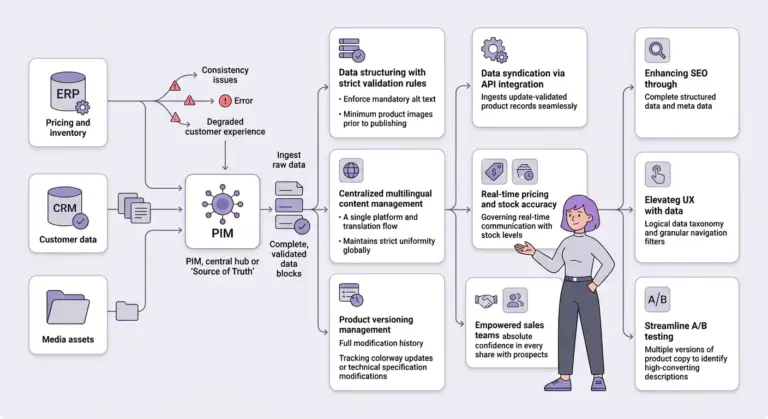
Technique: Clarify the distinctions between PIM, ERP systems (which focus on financial transactions and inventory management), and CRM platforms (which manage customer relationships). PIM focuses specifically on enriching, structuring, and preparing product data for sales channels.
1.2. The Challenge of Fragmented Data and Human Error
Technique: Explain why manually updating product specifications across multiple catalogs or websites leads to costly human error, brand dilution, and search engine penalties for inconsistent or duplicate content.
1.3. Content Enrichment
Technique: PIM provides the necessary environment to augment raw ERP data with non-technical sales assets, such as brand storytelling, value propositions, image Alt Text, and extended marketing copy.
2. PIM as the Core Content Engine for Smart Catalogs
PIM takes responsibility for data quality control and completeness before feeding information to the catalog.
2.1. Data Structuring and Validation Rules
Technique: PIM ingests raw or incomplete data from the ERP, then structures and validates it based on strict business rules (e.g., enforcing mandatory Alt Text and requiring a minimum of three product images prior to publishing).
2.2. Centralized Multilingual Content Management
Technique: PIM offers a single platform to manage and translate descriptive copy across multiple languages while maintaining strict uniformity for technical specifications and product SKUs globally.
2.3. Product Versioning Management
Technique: PIM tracks the full modification history of a product (e.g., colorway updates or technical spec modifications), enabling the catalog to display specific versions at scheduled times.
Read More
Smart Catalog Integration via API: Connecting to ERP, CRM, and E-commerce Systems
Catalog Workflow Management for Distributed and Enterprise Teams
Comparing Smart Catalog Platforms: Issuu, FlipHTML5, and Local Solutions
Seasonal Content Management: Update Strategies for Catalog Promotions
3. PIM and Catalog Integration: Sales Synergy
Working in tandem, these two systems unlock the full potential of digital sales execution.
• 3.1. Automated Data Syndication
Technique: The smart catalog (acting as a primary distribution channel for PIM) ingests up-to-date, validated product records seamlessly via API integrations, eliminating manual data entry.
3.2. Guaranteeing Real-Time Pricing and Stock Accuracy
Technique: While PIM governs enriched marketing content, it maintains active real-time communication with the ERP to stream live pricing and stock levels straight to the catalog display.
3.3. Empowering B2B Sales Teams
Technique: Armed with a single source of truth (PIM), B2B sales representatives can utilize the catalog with absolute confidence that every commercial term and technical parameter shared with prospects is 100% accurate.
4. The Impact of PIM on SEO, UX, and CRO
PIM forms the foundational bedrock for superior search rankings and site health.
4.1. Enhancing SEO Through Structured Data
Technique: By providing complete, rich, and consistent Meta Titles, Descriptions, and Alt Text, PIM directly powers catalog SEO and resolves "Thin Content" penalties.
4.2. Elevating User Experience (UX)
Technique: PIM ensures logical data taxonomy and granular navigation filters, helping buyers locate items faster and lowering bounce rates across catalog pages.
4.3. Streamlining A/B Testing for Conversion Optimization
Technique: By effortlessly managing multiple versions of product copy, PIM allows marketing teams to run A/B tests to identify high-converting descriptions (CRO).
Read More
The Importance of CDN in Digital Catalogs: How to Optimize Loading Speed by 100%?
B2B Smart Catalog Strategy: RFP Automation, Lead Generation & Sales Team Management
The Final Digital Catalog SEO Checklist: 25 Steps to Google Rank #1
Product Page Layout Design Techniques in Smart Catalogs: Arranging for Maximum Conversion Rates
15 Advanced CRO Techniques to Boost Sales Conversion Rate from Smart Catalogs
Final Words
Product Information Management (PIM) is an indispensable strategic investment for any enterprise scaling sales through smart catalogs. By converting raw data into rich, sales-driven content, PIM not only guarantees accuracy and cross-channel consistency but also underpins a robust SEO strategy, an effortless user experience, and higher conversion rates. The smart catalog is the successful presentation layer of an effective PIM strategy.